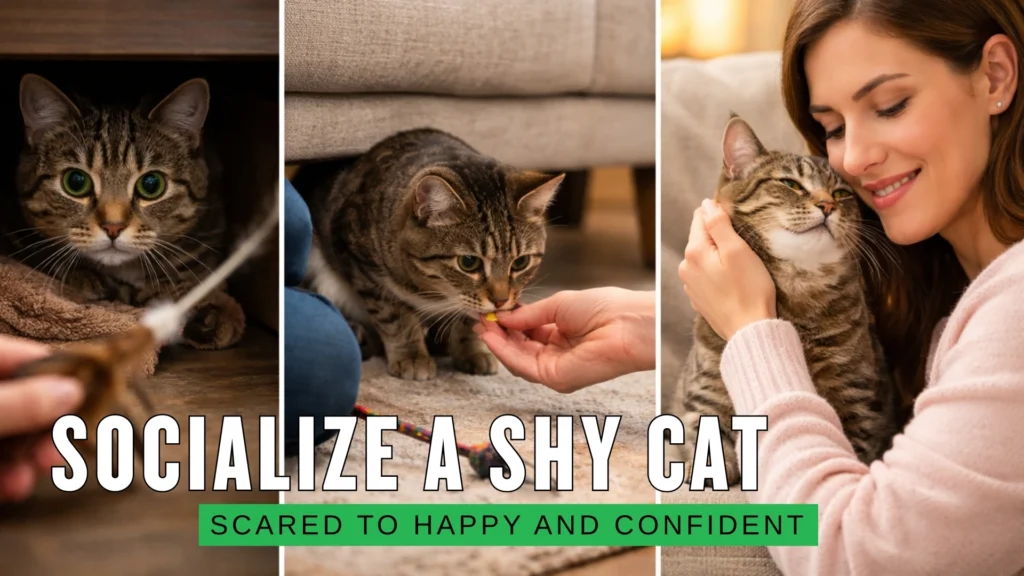

How to socialize a shy cat takes patience, consistency, and a deep respect for feline boundaries. With the right approach, even the most fearful cat can transform into a confident, loving companion.
If you have ever adopted a cat that immediately disappeared under the bed and refused to come out for days, you know the particular heartache of a shy cat. You want to help. You want to connect. But every attempt to reach out seems to push them further away.
The good news? Knowing how to socialize a shy cat is a learnable skill and it works. Thousands of cats that once hid in corners, hissed at every sound, and refused human touch have been successfully socialized into confident, affectionate companions. It does not happen overnight, but the transformation is deeply rewarding for both the cat and the owner.
In this comprehensive guide, we cover everything you need to know about how to socialize a shy cat from understanding why cats become shy in the first place, to a step-by-step process for building trust, to expert tips for handling setbacks along the way.
UNDERSTANDING WHY CATS BECOME SHY: THE ROOT CAUSES
Before you can effectively socialize a shy cat, you need to understand what made them shy in the first place. Shyness in cats is almost never a permanent personality defect; it is almost always a response to experience, environment, or early development.
THE SOCIALIZATION WINDOW
The single most important factor in feline shyness is the socialization window, the period between 2 and 7 weeks of age during which kittens are neurologically primed to learn what is safe and what is dangerous. Kittens that experience positive, gentle human contact during this window are far more likely to grow into confident, sociable cats. Kittens that are isolated, feral, or poorly handled during this period often grow into shy, fearful adults.
This does not mean shy cats are permanently damaged; it simply means their baseline is fear, and socialization work involves patiently rewriting that baseline.
TRAUMA AND NEGATIVE EXPERIENCES
Cats that have experienced abuse, neglect, rehoming stress, or frightening events (loud noises, aggressive animals, rough handling) may develop generalised fear responses. A cat that was once confident can become shy after a traumatic experience. Rescue cats and shelter cats are particularly prone to shyness for this reason.
GENETICS AND TEMPERAMENT
Some cats are simply born with a more cautious, reactive nervous system. Studies on feline temperament suggest that the father’s boldness significantly influences a kitten’s confidence level even when the kitten has never met its father. Genetically timid cats can absolutely be socialized, but they may always lean toward the cautious end of the spectrum.
HEALTH ISSUES
It is worth noting that sudden shyness or behavioural changes in a previously confident cat are often signs of pain or illness. Before beginning any socialization work, rule out medical causes with a veterinary checkup. A cat in pain will be defensive, withdrawn, and difficult to approach for good reason.
HOW TO TELL IF YOUR CAT IS SHY OR SIMPLY INDEPENDENT
Not every cat that avoids you is shy. Some cats are naturally independent and prefer their own company; this is a personality trait, not a problem to be solved. Understanding the difference helps you set realistic expectations and avoid pushing an independent cat into unnecessary stress.
Signs of a genuinely shy or fearful cat include:
- Hiding for extended periods (days, not just hours)
- Flattened ears, dilated pupils, and a puffed tail when approached
- Hissing, growling, or swatting as a first response
- Refusing food when humans are present
- Freezing in place when touched
- Trembling or crouching low to the ground
Signs of a simply independent cat include:
- Choosing to be alone but eating normally
- Making eye contact and slow blinking from a distance
- Occasionally seeking affection on their own terms.
- Comfortable in their environment, not visibly stressed
If your cat shows the first set of signs, they need patient socialization work. If they show the second set, they may simply prefer a more hands-off relationship, and that is perfectly okay.

HOW TO SOCIALIZE A SHY CAT: A STEP-BY-STEP GUIDE
Here is the core of what you came for: a proven, step-by-step process for socializing a shy cat. This process is endorsed by feline behaviourists, veterinary professionals, and experienced rescue workers. Work through these steps at your cat’s pace, not yours.
STEP 1: CREATE A SAFE BASE ROOM
When you first bring a shy cat home or when beginning socialization work with an existing shy cat, start by confining them to a single, quiet room. This is called a “base room” or “safe room”, and it is one of the most effective tools in learning how to socialize a shy cat.
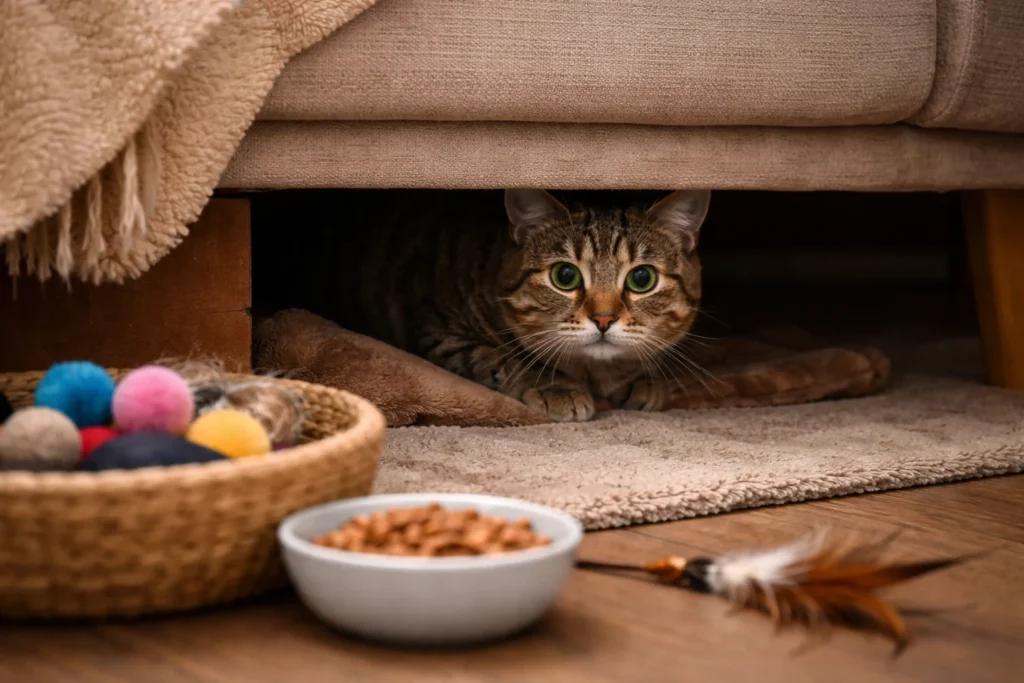
The base room should contain everything the cat needs: litter box, food, water, a cosy hiding spot (a cardboard box with a blanket works perfectly), and some toys. The room should be away from heavy foot traffic, loud appliances, and other pets.
The reason this works is simple: a smaller, predictable space is far less overwhelming than an entire house. A shy cat in a base room can gradually learn that their immediate environment is safe, which is the essential first step toward trusting the humans in it.
Keep the base room quiet. Speak softly near the door. Do not force entry or interaction. Simply let the cat exist in the space and begin building a sense of safety.
STEP 2: ESTABLISH A PREDICTABLE ROUTINE
Shy cats are deeply comforted by predictability. One of the most powerful things you can do to socialize a shy cat is to establish a consistent daily routine. Feed your cat at the same time every day. Clean the litter box on a schedule. Visit the room at the same time. Speak in the same calm tone.
Routine tells a shy cat that the world is not random and chaotic, that they can predict what will happen next. Over time, this predictability builds a sense of safety that makes the cat more open to new experiences, including interaction with humans.
Avoid sudden changes, loud sounds, or unexpected visitors during the early stages of socialization. Even well-meaning friends wanting to “meet the new cat” can set back weeks of progress if the introduction is poorly timed.
STEP 3: USE SCENT TO BUILD FAMILIARITY
Cats experience their world primarily through scent. Before any visual or physical contact, introduce your scent in a non-threatening way. Place an item of worn clothing, a t-shirt or a sock near the cat’s sleeping area. Do not wash it first; your natural scent is what the cat needs to process.
Leave the item there for several days. You are essentially giving the cat the opportunity to “meet” you on their own terms, through scent, without any pressure. Many shy cats will eventually sniff, knead, and even sleep on the scented item, a significant sign of growing comfort.
You can also try rubbing a cloth on your hands and face, then leaving it near the cat’s food bowl. This associates your scent with something positive, a technique sometimes called “scent trading.”
STEP 4: SIT NEAR THEM — WITHOUT INTERACTING
Once your cat is eating regularly and not constantly hiding, begin spending time in the room with them, but without making any attempt to interact. Bring a book, your phone, or a laptop. Sit on the floor (lower is less threatening than looming over them from a chair). Stay quiet. Do not make eye contact. Do not
reach out.
This technique works because it teaches the shy cat that your presence does not automatically mean threat. Many shy cats, given enough quiet sit-ins, will eventually inch closer out of curiosity. When they do, resist the urge to respond; let them control the interaction entirely.
This phase can take days or weeks, depending on the cat’s baseline fear level. Do not rush it. The goal is simply for the cat to feel that sharing space with you is safe.
STEP 5: INTRODUCE TREATS AS A BRIDGE
Food is one of the most powerful tools available when you are learning how to socialize a shy cat. Once your cat is comfortable with you being in the room, begin offering high-value treats, such as small pieces of cooked chicken, freeze-dried fish, or commercial cat treats, to bridge the distance between you.
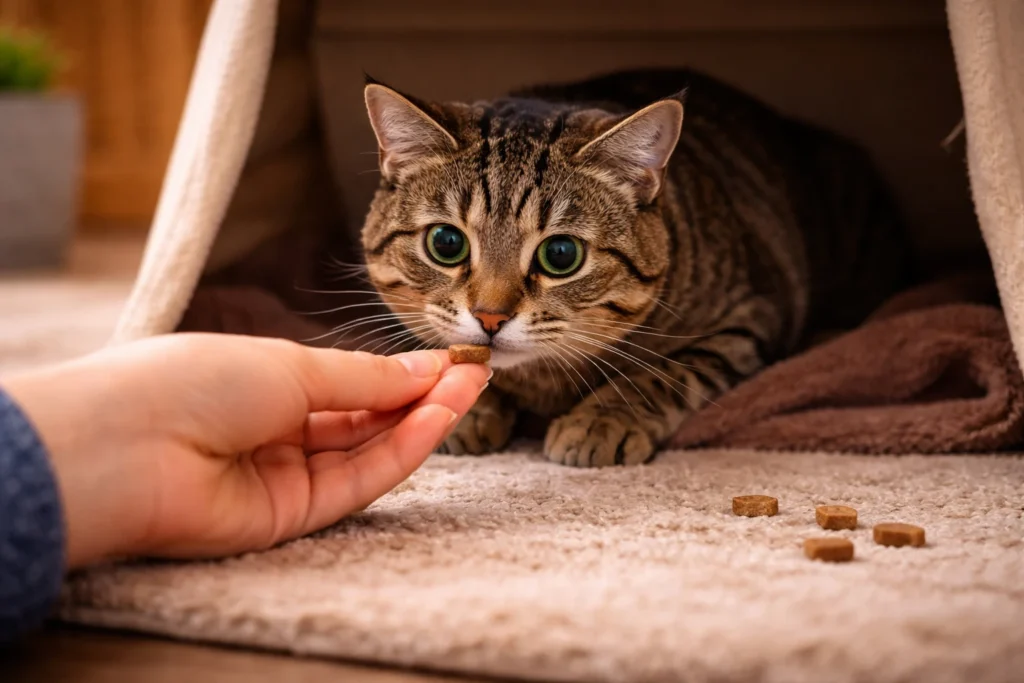
Start by placing treats several feet away from where you are sitting. As the cat grows comfortable taking treats at that distance, gradually move them closer. Eventually, try offering treats from your open, flat palm, no grabbing, no sudden movements.
The first time a shy cat eats from your hand is a landmark moment. It means they have decided that the reward outweighs the risk of proximity. From this point, trust tends to accelerate.
STEP 6: INTRODUCE GENTLE TOUCH — ON THEIR TERMS
Never reach for a shy cat to pet them; this activates their fight-or-flight response, even if they were otherwise comfortable. Instead, extend one finger toward them at their nose level and let them come to you. If they sniff your finger and rub against it, that is an invitation to gently scratch behind the ears or under the chin.
If they turn away, freeze, or flatten their ears, stop. Do not push forward. Every retreat is data, not failure. Respect the boundary and try again later.
When petting does become comfortable, stick to the “safe zones”: the top of the head, behind the ears, under the chin, and along the cheeks. Avoid the belly, the base of the tail, and the legs until the cat explicitly invites contact in those areas.
Keep early petting sessions short, two to three minutes maximum. End on a positive note, before the cat shows signs of stress. Leaving them wanting slightly more is far better than pushing past their comfort zone.
STEP 7: INTRODUCE PLAY AS A CONFIDENCE BUILDER
Play is transformative for shy cats. Not only does it provide physical exercise and mental stimulation, but it also builds confidence and creates positive associations with human-directed activity. A cat fully engaged in chasing a feather wand has momentarily forgotten to be afraid.
Use wand toys and toys on strings rather than hands or fingers. You want the cat focused on the toy, not on you. Move the toy in erratic, prey-like patterns. Let the cat catch it frequently. A cat that “wins” at hunting play feels more capable and confident in their environment.
Over time, play sessions create a powerful positive association with your presence. Your shy cat will begin to look forward to seeing you because you are the one who brings the fun.
STEP 8: EXPAND THEIR WORLD GRADUALLY
Once your cat is confident in their base room, begin slowly expanding their access to the rest of the home. Open the base room door and let them explore on their own schedule. Do not carry them into new spaces; let them choose when to investigate.
Place familiar-scented items (their blanket, a piece of your clothing) in the new areas they will encounter. This makes the unfamiliar smell slightly more familiar. Keep the rest of the household quiet during the exploration phase. If you have other pets, use a controlled introduction process (see below).
Give the cat safe retreat points in every room: a cat tree, a space under a bed, a covered cat bed. A cat that always has an escape route is a cat that feels safe enough to venture further.
HOW TO SOCIALIZE A SHY CAT WITH OTHER PETS
Introducing a shy cat to existing pets is one of the most delicate parts of the socialization process. Done poorly, it can set back months of progress. Done carefully, it can result in a shy cat finding a confident companion who models calm, secure behaviour.
WITH OTHER CATS:
Follow the classic “slow introduction” protocol. Keep the cats completely separated for at least one to two weeks. Then swap bedding between them so they can process each other’s scent without visual contact. Next, allow them to smell each other under a closed door. Only after these stages should you attempt visual contact through a baby gate or a slightly opened door.
Never force cats together. Let them set the pace. Hissing and growling during early visual contact is normal and not a sign of permanent incompatibility. Most cats reach a stable truce within four to eight weeks of careful introduction.
WITH DOGS:
A shy cat and a dog require even more careful management. The dog must be well-trained and reliably responsive to commands. Keep the dog on a leash for initial introductions. Allow the cat to observe the dog from a high, safe vantage point. Never allow the dog to chase the cat, even once, as this can create a lasting fear response that is very difficult to undo.
Ensure the shy cat always has dog-free zones they can retreat to: rooms with baby gates, the cat can jump over, high perches, or dedicated cat-only spaces.
COMMON MISTAKES TO AVOID WHEN SOCIALIZING A SHY CAT
Even well-intentioned owners make mistakes that unintentionally set back socialization progress. Here are the most common pitfalls to avoid.
MISTAKE #1: MOVING TOO FAST
Trying to accelerate the process by forcing contact, carrying the cat around, or flooding them with human interaction is one of the most common and most damaging mistakes. It causes the cat to associate human interaction with overwhelming stress, the opposite of what you are trying to achieve. Always follow the cat’s pace, not yours.
MISTAKE #2: STARING DIRECTLY AT THE CAT
Direct eye contact is a threat signal in feline body language. Staring at a shy cat, even with friendly intentions, can make them feel cornered and unsafe. Instead, use slow blinks (the cat equivalent of a smile), look slightly to the side, and let the cat make eye contact first.
MISTAKE #3: LOUD VOICES AND SUDDEN MOVEMENTS
Shy cats have sensitive nervous systems. Raised voices, sudden movements, and unexpected sounds (dropped objects, slamming doors) can trigger stress responses that linger for hours. During the socialization period, make a conscious effort to move slowly and speak softly in the cat’s presence.
MISTAKE #4: INCONSISTENCY
Socialization only works with consistent effort. Spending three intense days on the process and then ignoring the cat for a week is counterproductive. Short, daily sessions are far more effective than long, infrequent ones. Consistency is the single biggest predictor of socialization success.
MISTAKE #5: PUNISHING FEARFUL BEHAVIOR
Hissing, swatting, and hiding are not bad behaviours; they are stress responses. Punishing a shy cat for these behaviors (using a spray bottle, raised voice, or physical correction) adds fear on top of fear and permanently damages trust. Instead, respond to fearful behavior by calmly backing off and giving the cat more space.
HOW LONG DOES IT TAKE TO SOCIALIZE A SHY CAT?
This is one of the most commonly asked questions about how to socialize a shy cat, and the honest answer is: it depends.
Kittens (under 6 months): With consistent work, shy kittens can often be socialized to a comfortable baseline within 2 to 6 weeks. The younger they are, the more neurologically flexible they are.
Adult cats with limited early socialization: Expect 3 to 6 months of patient, consistent work before significant improvement is visible. Some cats plateau at a level of “tolerant but not cuddly”, and that is a perfectly valid outcome.
Adult cats with trauma histories: These cats may take 6 months to a year or more, and some may never become fully comfortable with strangers or in chaotic environments. However, they can still form deep, trusting bonds with their primary caregiver.
Feral cats: Adult feral cats that have never been socialized are the most challenging cases. Some can be socialized to indoor life over 12 to 24 months of dedicated work. Others may remain fearful of humans their entire lives, but can still live comfortably as “semi-feral” indoor cats with a patient owner.
The most important thing to remember is that any progress, no matter how little, is worth celebrating. A cat that was hiding under the bed for three weeks and now eats in the same room as you is making enormous progress. Honour every step.
WHEN TO SEEK PROFESSIONAL HELP
Most shy cats can be socialized with patience and the steps outlined above. However, some situations call for professional guidance.
Consider consulting a certified feline behaviorist if:
- Your cat has not eaten for more than 48 hours due to fear.
- Your cat is self-harming (over-grooming, pulling fur out)
- The cat shows extreme aggression (not just defensive swatting but sustained, escalating attacks)
- You have followed the socialization steps consistently for 6+ months with no improvement
- You suspect your cat’s fear may be related to a medical condition.
A veterinarian can also prescribe short-term anti-anxiety medications or calming supplements (such as Zylkene or Feliway) that can take the edge off severe fear responses and make behavioral work more effective. Medication is not a substitute for socialization work, but it can make the process more accessible for severely fearful cats.
TOOLS AND PRODUCTS THAT HELP SOCIALIZE A SHY CAT
Alongside behavioral techniques, several products are widely recommended by feline behaviorists to support shy cat socialization.
FELIWAY DIFFUSER
Feliway is a synthetic version of the feline facial pheromone that cats release when they rub their faces on objects, a behavior associated with contentment and security. Plugging a Feliway diffuser into the base room creates a subtle environmental signal that says, “this space is safe.” Multiple studies support its effectiveness in reducing feline stress and fear responses.
THUNDERSHIRT FOR CATS
Originally designed for dogs, Thundershirt makes a cat version, a snug-fitting wrap that applies gentle, constant pressure, similar to swaddling. Some shy cats respond very well to this during particularly stressful events (such as vet visits, new guests, or thunderstorms).
PUZZLE FEEDERS
Puzzle feeders engage a shy cat’s brain and instincts, providing enrichment that builds confidence. A cat that successfully hunts for its food (even in a living room context) feels more capable and secure in its environment.
HIDING BOXES AND CAT TUNNELS
Providing plenty of covered hiding spots paradoxically makes shy cats braver. A cat that always has a retreat available feels safe enough to venture out. Cardboard boxes, paper bags with handles removed, and commercial cat tunnels all work well.
HIGH PERCHES
Height gives cats a sense of control and safety. A cat that can observe the room from above feels significantly less vulnerable than one trapped at ground level. A cat tree or wall-mounted shelving can transform a shy cat’s willingness to be present in shared spaces.
SOCIALIZING A SHY RESCUE CAT: SPECIAL CONSIDERATIONS
Rescue cats deserve a special mention because they make up a significant proportion of shy cats in homes. Many rescue cats have unknown histories, multiple rehoming experiences, or time spent in the stressful shelter environment, all of which compound shyness.
When you adopt a rescue cat, resist the urge to “show them love” through immediate handling and interaction. What they need first is safety, not affection. Follow the base room protocol strictly for at least two weeks before attempting any hands-on socialization.
Ask the rescue organization for everything they know about the cat’s history any known triggers, previous names, foods they responded to, and progress made during foster care. This information can save weeks of trial and error.
Be especially patient with rescue cats that have been returned to shelters multiple times. These cats have learned that humans eventually leave, and they protect themselves from that pain by not bonding. Earning their trust takes longer, but the bond that forms is often exceptionally deep.
CONCLUSION: THE JOURNEY FROM SCARED AND HIDING TO HAPPY AND CONFIDENT
Learning how to socialize a shy cat is one of the most rewarding journeys a cat owner can undertake. It requires slowing down, letting go of expectations, and communicating entirely on another species’ terms. It demands patience on days when progress feels invisible and perseverance through inevitable setbacks.
But the moment your once-terrified cat walks toward you of their own accord, blinks slowly, and presses their forehead to yours, all of that patience collapses into something extraordinary. You have not just gained a pet. You have earned the trust of a creature that chose fear as its default setting and decided, because of you, to choose something different.
The transformation from scared and hiding to happy and confident does not happen in a straight line. It is messy, slow, and deeply personal. But it happens. And when it does, you will have built one of the most profound bonds that exists between humans and animals.
Start where your cat is. Move at their pace. Trust the process. Your shy cat’s confident future is closer than you think.