

Dog intelligence is real, measurable, and fascinatingly complex. Have you ever watched a Border Collie solve a puzzle in seconds while a Basset Hound stares blankly at the same toy for minutes? You are not imagining things.
Dogs have lived alongside humans for over 15,000 years. During that time, we bred them for specific jobs: herding, hunting, guarding, and companionship. Those jobs demanded very different mental skills. The result? Today, we have over 340 recognized dog breeds, each carrying a unique cognitive fingerprint shaped by centuries of selective breeding.
But what exactly is dog intelligence? Is it just about following commands? Can we truly measure how smart a dog is? And why do some breeds consistently outperform others in cognitive tests?
In this comprehensive guide, we break down the science of dog intelligence, what it means, how it works, which breeds have it in abundance, and why that difference exists in the first place.
Whether you are a curious pet owner, a prospective dog buyer, or simply a dog lover, this article will give you a science-backed, in-depth understanding of canine cognition that goes far beyond simple rankings.
WHAT IS DOG INTELLIGENCE? DEFINING CANINE COGNITION
Dog intelligence is not a single, one-dimensional trait. Just like human intelligence, which includes emotional intelligence, logical reasoning, creativity, and memory, canine intelligence is multi-layered.
Dr. Stanley Coren, a psychologist and leading expert in canine cognition at the University of British Columbia, introduced one of the most widely referenced frameworks for understanding dog intelligence. In his landmark book “The Intelligence of Dogs” (1994), Coren identified three distinct dimensions of canine intelligence:
1. INSTINCTIVE INTELLIGENCE
This refers to what a dog was bred to do naturally, without any human training. A Border Collie instinctively herds animals. A Bloodhound instinctively follows a scent trail. A Labrador Retriever instinctively picks up objects with a soft mouth. These behaviors are genetically hardwired and represent the dog’s baseline, breed-specific intelligence.
2. ADAPTIVE INTELLIGENCE
This is a dog’s ability to learn from its environment and solve problems independently. Adaptive intelligence measures how well a dog can figure things out on its own, like opening a gate latch, remembering where food is hidden, or understanding that a person is upset. This dimension varies significantly from individual to individual, even within the same breed.
3. WORKING AND OBEDIENCE INTELLIGENCE
This is what most people mean when they call a dog “smart”: the ability to learn from humans, follow commands, and repeat learned behaviors consistently. This is the dimension on which Coren ranked breeds, based on surveys of over 200 professional dog obedience judges across the United States and Canada.
Understanding these three layers is essential because a dog that ranks low in obedience intelligence might rank extremely high in adaptive intelligence. A Siberian Husky, for example, is notoriously stubborn in training sessions, but in the wild or in sled conditions, it demonstrates extraordinary problem-solving and navigational skills.
Dog intelligence, in other words, is always context-dependent.
THE SCIENCE BEHIND HOW DOGS THINK
To understand dog intelligence, we must first understand the dog’s brain.
THE DOG BRAIN: SIZE, STRUCTURE, AND FUNCTION
A dog’s brain is roughly the size of a tangerine, weighing about 72 grams on average. While that is significantly smaller than the human brain (which weighs approximately 1,350 grams), size alone does not determine intelligence. What matters more is the ratio of brain size to body size, and more importantly, the structure and connectivity of neural networks.
Dogs have a highly developed olfactory cortex, the part of the brain responsible for processing smell. It is roughly 40 times larger (relative to brain size) than the human olfactory cortex. This explains why dogs can track scents across miles, detect diseases like cancer, and identify individual humans by scent alone.
However, the prefrontal cortex, the region associated with complex reasoning, planning, and self-control, is less developed in dogs compared to primates. This means dogs excel at instinctive and emotional cognition but have limits in abstract reasoning.
HOW DOGS PROCESS INFORMATION
Research from Dr. Brian Hare at Duke University’s Canine Cognition Center has revolutionized our understanding of how dogs think. His studies showed that dogs have evolved a unique social intelligence: they are extraordinarily skilled at reading human communication cues far better than even chimpanzees, our closest genetic relatives.
When you point at something, a dog understands that you are directing its attention to that object. Chimpanzees, despite their superior general intelligence, largely fail this test. Dogs, through thousands of years of co-evolution with humans, have developed a specialized ability to understand human gestures, gaze, and emotions.
This is not just training, it is evolution. Dog cognitively tuned to humans in a way no other species is.
DOGS AND EMOTIONAL INTELLIGENCE
Dogs are also remarkably emotionally intelligent. Studies published in journals like “Animal Cognition” and “Learning & Behavior” have shown that:
– Dogs can recognize human facial expressions (happy vs. angry)
– Dogs experience primary emotions, including joy, fear, anger, disgust, and love
– Dogs show empathy; they comfort humans who are crying, sometimes even strangers
– Dogs can distinguish between fair and unfair treatment (a basic sense of justice)
In fact, neuroimaging studies using MRI have confirmed that when dogs see their owners, their brains release oxytocin, the same “love hormone” released in human bonding. The bond between a dog and its owner is neurochemically similar to the bond between a parent and child.
This emotional attunement is itself a form of intelligence, one that most intelligence rankings fail to fully capture.
THE TOP 10 MOST INTELLIGENT DOG BREEDS AND WHY THEY RANK SO HIGH
Based on Dr. Coren’s research and subsequent studies in canine cognition, here are the top 10 most intelligent dog breeds, along with the cognitive reasons behind their ranking:
1. BORDER COLLIE
Often called the Einstein of dogs, the Border Collie tops virtually every dog intelligence list. Originally bred to herd sheep across the rugged terrain of Scotland and England, Border Collies needed to make fast, independent decisions, reading the flock, anticipating movement, and responding to subtle human signals from hundreds of meters away.
Their working intelligence is unmatched: they can learn a new command in fewer than 5 repetitions and obey known commands on the first attempt 95% of the time or better. Chaser, a famous Border Collie studied by researcher Dr. John Pilley, learned over 1,000 words more than any other non-human animal ever documented.
2. POODLE
Behind the fancy haircut is one of the sharpest canine minds in existence. Poodles were originally water retrievers in Germany, bred to swim into cold rivers and retrieve ducks and waterfowl. This job required intense problem-solving, spatial awareness, and quick learning.
Poodles come in three sizes (Standard, Miniature, Toy) and all three consistently rank at the top of intelligence assessments. They are highly trainable, emotionally sensitive, and capable of learning complex multi-step tasks.
3. GERMAN SHEPHERD
German Shepherds are perhaps the most versatile intelligent dogs on the planet. They work as police K9s, military dogs, search-and-rescue specialists, guide dogs, and psychiatric service animals, often simultaneously mastering multiple complex skill sets.
Their cognitive strength lies in their ability to apply learned skills to novel situations. A German Shepherd trained in drug detection, for instance, can generalize that skill to detect new chemical compounds it has never encountered before. This is a hallmark of high adaptive intelligence.
4. GOLDEN RETRIEVER
Golden Retrievers combine high obedience intelligence with extraordinary emotional intelligence. Bred as gun dogs to retrieve game in the Scottish Highlands, they needed to be gentle, precise, and highly attuned to their human partner.
Their emotional sensitivity makes them ideal therapy and service dogs. Research shows that Golden Retrievers are among the best at reading human emotions. They will often approach a crying person before a calm one, even in a room full of strangers.
5. DOBERMAN PINSCHER
Bred in the late 19th century by German tax collector Louis Dobermann specifically to create the perfect guard and protection dog, the Doberman is fiercely intelligent, alert, and strategic. Dobermans can assess threats rapidly, maintain focus for long periods, and execute complex protection commands under pressure. Their intelligence is paired with loyalty and courage, making them among the most effective working dogs in the world.
6. SHETLAND SHEEPDOG (SHELTIE)
A miniature cousin of the Rough Collie, the Sheltie was bred to herd in the challenging terrain of the Shetland Islands. What makes Shelties particularly remarkable is their sensitivity to human emotion combined with high working intelligence. They are known to anticipate commands before they are given, reading micro-expressions and body language with uncanny accuracy.
7. LABRADOR RETRIEVER
The world’s most popular dog breed is also among its smartest. Labradors were bred by fishermen in Newfoundland, Canada, to retrieve fishing nets and catch fish from icy waters, a task that required cooperation with humans, problem-solving, and physical endurance.
Their balance of working intelligence and social adaptability makes them the preferred breed for guide dog programs worldwide. Approximately 70% of all guide dogs trained are Labradors or Labrador crosses.
8. PAPILLON
Don’t let the small size fool you. The Papillon (French for “butterfly,” named for its distinctive wing-shaped ears) consistently outperforms breeds ten times its size in intelligence tests. Papillons excel in agility competitions and obedience trials, demonstrating quick learning, precise memory, and an eagerness to work that rivals herding breeds.
9. ROTTWEILER
Rottweilers were originally Roman cattle-driving dogs, bred to herd livestock and pull carts. They possess powerful working memory, strong situational awareness, and a strategic mind. Modern Rottweilers serve in police, military, and search-and-rescue roles, where their combination of physical strength and mental sharpness is invaluable.
10. AUSTRALIAN CATTLE DOG (BLUE HEELER)
Developed in Australia specifically to herd cattle in harsh outback conditions, the Australian Cattle Dog is independent, resourceful, and relentlessly energetic. Their adaptive intelligence is particularly high; they are problem-solvers by nature, capable of figuring out fences, gates, and obstacles that stump other breeds.

WHY DO SOME BREEDS THINK DIFFERENTLY? THE REAL REASONS
This is the heart of the question. Why do Border Collies think so differently from Basset Hounds? Why does a Poodle learn a new trick in minutes while a Chow Chow needs weeks?
The answer lies in a combination of genetics, selective breeding history, neurological structure, and evolutionary purpose.
REASON 1: SELECTIVE BREEDING FOR COGNITIVE TRAITS
Every dog breed was created (or refined) by humans for a specific purpose. That purpose dictated not just physical traits, size, coat, and build, but mental ones. When breeders selected the “best” sheepdogs for herding, they were unconsciously selecting for the mental traits that made herding possible: focus, quick decision-making, responsiveness to human cues, and spatial reasoning.
Over generations, these cognitive traits became embedded in the breed’s genetic code. A Border Collie puppy raised in a city apartment, with zero exposure to sheep, will still display herding instincts, crouching, stalking, and circling anything that moves. The intelligence was bred in.
Conversely, Basset Hounds were bred to track scents slowly and persistently over long distances. For this job, stubbornness (not giving up the trail) and independence (working far ahead of the hunter) were virtues, not flaws. A Basset Hound ranks low on obedience intelligence, not because it is “dumb” but because following a human’s commands was never part of its job description.
REASON 2: NEUROLOGICAL DIFFERENCES BETWEEN BREEDS
A 2019 study published in the Journal of Neuroscience by researchers at the University of Georgia performed MRI brain scans on 62 dogs from 33 different breeds. They found significant, measurable differences in brain structure and neural network connectivity between breeds, and these differences corresponded to the breed’s historical function.
For example:
– Breeds bred for social roles (companion dogs, therapy dogs) showed stronger connectivity in brain regions associated with social cognition and emotional processing.
– Herding and working breeds showed stronger connectivity in regions associated with decision-making and motor planning.
– Scent hounds showed larger and more connected olfactory processing regions.
In other words, different breeds have literally different brains shaped by selective breeding over centuries to optimize for different cognitive tasks.
REASON 3: THE ROLE OF THE OXYTOCIN SYSTEM
Research from Nagasaki University in Japan found that breeds with higher human-directed gazing behavior (looking into human eyes) had stronger oxytocin feedback loops between dogs and their owners. This gaze-oxytocin loop is key to human-dog bonding and also facilitates faster learning from human cues.
Breeds that were historically bred to work closely with humans (herding dogs, retrievers) tend to have more active oxytocin systems, making them naturally more attuned to human communication and therefore faster at learning from us.
Breeds historically bred to work more independently (sled dogs, sighthounds, scent hounds) have weaker gaze-oxytocin responses. They are not less intelligent; they simply evolved to rely less on human guidance and more on their own cognition.
REASON 4: ENVIRONMENT AND EARLY EXPERIENCES
Genetics sets the ceiling of a dog’s potential intelligence, but environment determines how much of that potential is realized. Studies in canine cognition consistently show that:
– Puppies exposed to varied environments, problems, and social interactions in their first 3–16 weeks (the critical socialization window) develop significantly stronger cognitive abilities.
– Dogs raised in enriched environments with puzzle toys, varied experiences, and positive training demonstrate better problem-solving, memory, and adaptability throughout their lives.
– Stress and trauma in early puppyhood can suppress cognitive development, even in breeds with high genetic intelligence potential.
This means a well-raised Basenji (a breed that often ranks low in obedience intelligence) with a stimulating environment may cognitively outperform a neglected Border Collie. Nature and nurture work together.
THE MYTH OF THE “DUMB DOG” WHY LOW-RANKED BREEDS AREN’T LESS SMART
One of the most important things to understand about dog intelligence rankings is what they do NOT measure.
Dr. Coren’s rankings, the most widely cited in the world, are based almost entirely on working and obedience intelligence: how quickly a dog learns commands from humans. This is a useful metric for some purposes, but it is a deeply incomplete picture of overall dog intelligence.
Consider the Afghan Hound, which ranks near the bottom of most dog intelligence lists. The Afghan Hound is a sighthound, an ancient breed developed over thousands of years in the mountains of Afghanistan to hunt prey independently at high speed over long distances. In the field, an Afghan Hound must make split-second decisions, navigate complex terrain, and manage a hunt without human direction. These are extraordinary cognitive feats.
The Afghan Hound doesn’t score well on obedience tests for the same reason a surgeon doesn’t score well on a plumbing exam: the test measures the wrong skills.
Similarly, the Basenji, an ancient African hunting dog that does not bark, is often labeled “untrainable”. But the Basenji is extraordinarily resourceful, independent, and observant. In the forests of Central Africa, where it was bred, relying on human commands would have been a fatal weakness. Its intelligence is adapted for a completely different cognitive environment.
The deeper truth is this: every dog breed is smart in its own way. The question is not which breed is “most intelligent” in some universal sense, but rather, which type of intelligence does each breed excel at?
Low obedience intelligence often simply means high independent intelligence. These dogs think for themselves.
HOW TO TEST YOUR OWN DOG’S INTELLIGENCE
Want to assess your own dog’s cognitive abilities? Here are five simple, science-inspired tests you can do at home:
TEST 1: THE BLANKET TEST (Problem-Solving)
Gently place a large blanket or towel over your dog’s head. Start a timer. Measure how long it takes your dog to free itself.
– Under 15 seconds: Excellent problem-solving ability
– 15–30 seconds: Average
– Over 30 seconds: May have lower adaptive intelligence (or may just be very relaxed!)
TEST 2: THE TREAT-UNDER-CUP TEST (Short-Term Memory)
Let your dog watch you place a treat under one of three cups. Distract your dog for about a minute, then let it search. Can it go straight to the right cup?
– Goes directly to the correct cup: Strong short-term spatial memory
– Sniffs all cups before finding it: Average memory
– Cannot locate it: Lower spatial memory
TEST 3: THE POINTING TEST (Social Cognition)
Place two identical objects on the floor. Point clearly to one of them. Does your dog approach the one you pointed to?
– Follows your point immediately: High social and communicative intelligence
– Needs multiple signals: Average social cognition
– Ignores the gesture entirely: May have lower human-directed social cognition (or may just be independent-minded)
TEST 4: THE BARRIER TEST (Logical Reasoning)
Create a simple barrier (a baby gate or cardboard) with a gap on each side. Show your dog a treat on the other side of the center (not near the gaps). How long does it take to figure out that it must go around?
– Under 30 seconds: Strong logical reasoning
– 30 seconds to 2 minutes: Average
– Over 2 minutes: May struggle with spatial problem-solving
TEST 5: THE LOOK TEST (Emotional Intelligence)
Without saying anything, make your best sad or distressed facial expression while looking at your dog. Does it approach you, lick you, or show concerned body language?
– Approaches and tries to comfort you: High emotional intelligence
– Notices but does nothing: Moderate emotional sensitivity
– Doesn’t react: Lower emotional attunement (or a very independent personality)
Remember: these tests measure specific types of intelligence. A low score on one test doesn’t make your dog less smart; it may simply mean its intelligence shines in a different area.
HOW TO STIMULATE AND IMPROVE YOUR DOG’S INTELLIGENCE
Whether you have a brilliant Border Collie or a relaxed Basset Hound, every dog’s brain benefits from regular mental stimulation. Just like physical exercise keeps the body healthy, cognitive exercise keeps the mind sharp, and research shows it can actually slow cognitive aging in dogs.
Here are the most effective ways to boost your dog’s mental performance:
1. PUZZLE TOYS AND FEEDERS
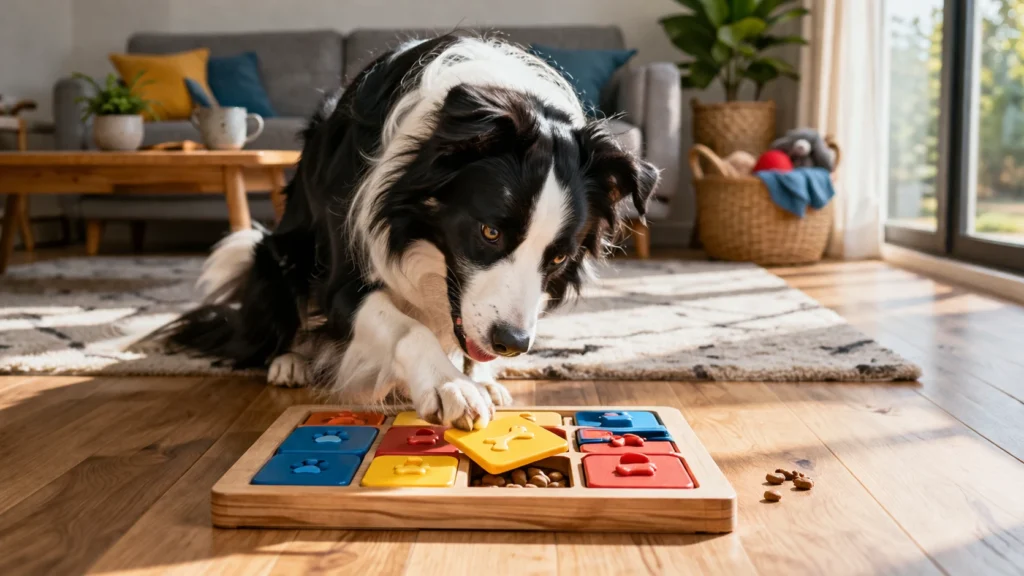
Interactive feeders and puzzle toys force dogs to problem-solve before they eat. These range from simple treat-dispensing balls to complex multi-step puzzle boards. They tap into adaptive intelligence and are especially beneficial for high-intelligence breeds that need constant mental challenges.
2. NOSE WORK AND SCENT GAMES
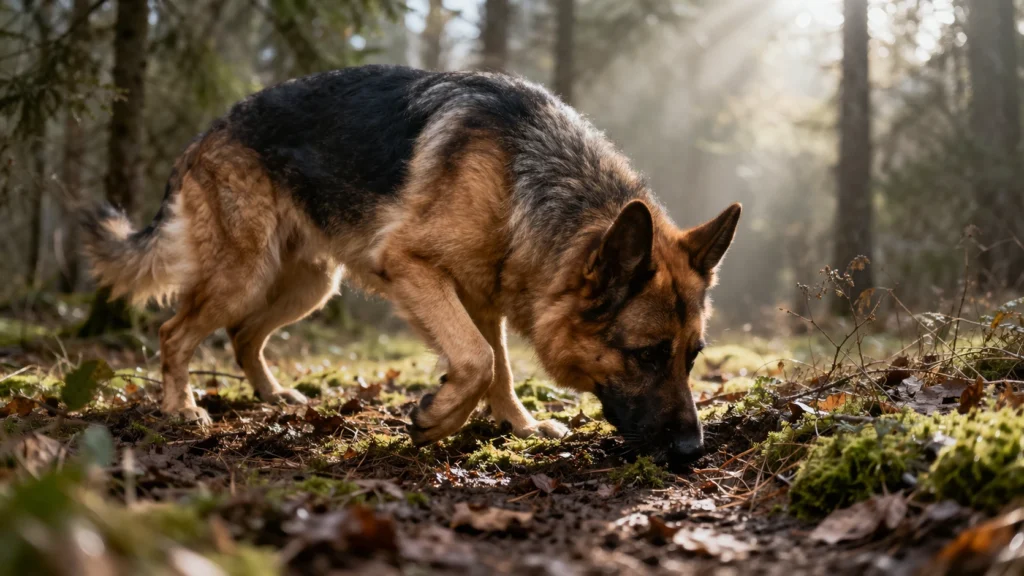
Hiding treats or scented objects around the house and encouraging your dog to find them is one of the most cognitively demanding activities you can offer. Scent work simultaneously activates the olfactory cortex, decision-making centers, and the dog’s emotional reward systems.
3. POSITIVE REINFORCEMENT TRAINING
Regular training sessions, even just 10–15 minutes a day, significantly improve a dog’s working memory, focus, and ability to generalize rules. The key is positive reinforcement: rewarding correct behavior rather than punishing mistakes. Punishment-based training has been shown to suppress creativity and problem-solving in dogs.
4. SOCIALIZATION
Exposure to new environments, people, animals, and situations builds cognitive flexibility, the ability to adapt thinking to new contexts. Dogs that are well-socialized throughout their lives maintain stronger cognitive function into old age.
5. LEARNING NEW COMMANDS AND TRICKS
Teaching an old dog new tricks is literally brain exercise. Every new command or trick creates new neural pathways. Research shows that dogs who continue learning new skills throughout their lives maintain sharper cognitive function and are less likely to develop Canine Cognitive Dysfunction (the dog equivalent of dementia).
6. PLAY AND INTERACTION
Unstructured play, especially with other dogs or with humans, is profoundly cognitively stimulating. During play, dogs practice social reading, strategic thinking, physical coordination, and emotional regulation simultaneously.
DOG INTELLIGENCE AND WHAT IT MEANS FOR CHOOSING A BREED
One of the most common mistakes prospective dog owners make is choosing a breed based on intelligence rankings alone and then being surprised when that “smart” dog becomes a destructive, anxious handful.
Here is the truth that most dog intelligence articles won’t tell you: the smartest dogs are often the hardest to own.
A Border Collie ranks number one in dog intelligence, but a Border Collie in an apartment with insufficient stimulation will destroy your furniture, develop anxiety, and potentially become aggressive. Their intelligence demands an outlet. Without one, it turns inward and destructive.
German Shepherds and Dobermans are extraordinarily smart, but they require experienced owners who can channel that intelligence appropriately. An under-stimulated or poorly trained German Shepherd can become a serious problem.
Meanwhile, a Cavalier King Charles Spaniel, which doesn’t crack the top 20 in intelligence rankings, is one of the most beloved and successfully kept companion dogs in the world. Its moderate intelligence, gentle nature, and adaptability make it a perfect match for millions of households.
When choosing a breed, consider:
– How much time do you have for training and mental stimulation?
– Does the breed’s historical purpose match your lifestyle?
– Are you an experienced dog owner, or is this your first dog?
– Do you want a dog that follows your lead, or one that thinks independently?
The “right” intelligence level is the one that matches your life, not the one at the top of the ranking chart.
CONCLUSION
Dog intelligence is one of the most fascinating, nuanced, and misunderstood topics in the world of animal cognition. The more scientists study it, the more complex and impressive it turns out to be.
Here is what we know for certain:
– Dog intelligence is multi-dimensional; it includes instinctive, adaptive, social, emotional, and working intelligence.
– Different breeds think differently because they were shaped by thousands of years of selective breeding for radically different cognitive tasks.
– The brain structures of different breeds are measurably different, optimized for their historical roles.
– No breed is universally “smarter” than another; they are differently intelligent, in ways precisely tailored to their evolutionary purpose.
– Every dog’s intelligence can be nurtured, developed, and expanded through enrichment, training, and positive relationships with humans.
Most importantly, dogs are cognitively extraordinary in ways that go far beyond obedience rankings. Their ability to read human emotions, bond with us through shared neurochemistry, and cooperate with us across species lines is a form of intelligence with no parallel in the animal kingdom.
The next time your dog looks into your eyes, really looks, with that deep, knowing gaze, remember: you are looking at the product of 15,000 years of co-evolution. A mind shaped, in part, by its relationship with yours.
That, perhaps, is the most remarkable thing about dog intelligence. It did not evolve in isolation. It evolved in partnership with us. And that makes it extraordinary.
Related Article:
Dog Destroy Things When Alone? Here’s Why & How to Fix It
Why Are Some Dogs Aggressive? How Early Life Experiences Shape Dog Behavior
Why Dogs Love Humans More Than Other Dogs: The Science of Dog Loyalty Explained
A: The Border Collie is widely considered the most intelligent dog breed in the world, based on Dr. Stanley Coren’s research on working and obedience intelligence. Border Collies can learn a new command in fewer than 5 repetitions and follow known commands 95% of the time.
A: Dog intelligence is typically measured across three dimensions: instinctive intelligence (breed-specific natural abilities), adaptive intelligence (problem-solving and environmental learning), and working/obedience intelligence (ability to learn from and follow human commands).
A: Yes, different dog breeds demonstrate measurably different cognitive abilities, but “smarter” depends on what you measure. Breeds rank differently depending on whether you measure obedience, problem-solving, emotional sensitivity, or independent thinking.
A: While genetics set the foundation, a dog’s cognitive abilities can be significantly developed through puzzle toys, nose work, positive reinforcement training, socialization, and regular learning of new commands. Mental stimulation is as important as physical exercise for a dog’s brain health.
A: Breeds that are harder to train are often not less intelligent; they were simply bred for independent work rather than close human collaboration. Sled dogs, scent hounds, and sighthounds evolved to think for themselves, making them less naturally focused on following human commands.
A: Yes. Research shows dogs can recognize human facial expressions, respond to emotional states, experience empathy, and form deep social bonds. MRI studies confirm that dogs release oxytocin (the bonding hormone) when interacting with their owners, the same neurochemical response found in human-to-human bonding.