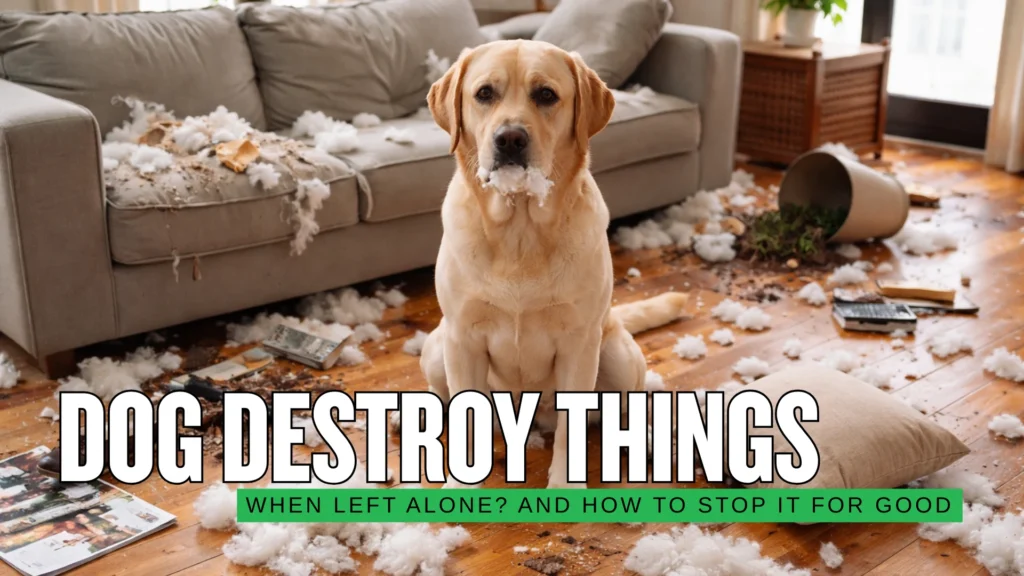

If your dog destroy things when left alone, you are not alone. This is one of the most common complaints dog owners have worldwide. It is frustrating, expensive, and if you do not understand why it is happening, it can feel completely hopeless.
You walk through the front door after a long day at work, and your heart sinks. The couch cushions are shredded. Your favorite shoes are unrecognizable. And your dog is sitting right in the middle of the chaos, tail wagging as if nothing happened.
Sound familiar?
But here is the truth: your dog is not being spiteful. They are not doing this to punish you. In fact, destructive dog behavior when left alone is almost always a sign that something deeper is going on emotionally, physically, or behaviorally.
In this article, we are going to break down the 5 real reasons dog destroy things when left alone, and more importantly, give you a clear, step-by-step plan to stop it for good. Whether your dog is a young puppy or a full-grown adult, these strategies work, and they are backed by animal behaviorists and veterinary science.
Let us get into it.
UNDERSTANDING THE ROOT CAUSE
Before we jump into solutions, it is critical to understand that dog destroy things when left alone for specific, identifiable reasons. Destruction is never random behavior; it is always communication.
Dogs do not have words. They cannot text you to say “I am stressed” or “I am bored.” Instead, they express their inner world through behavior. And when that behavior involves your furniture, your shoes, or your walls, it is your dog’s way of saying something is wrong.
The mistake most dog owners make is treating the symptom (the destruction) without addressing the cause. That is like taking painkillers for a broken bone without ever setting it. You might get temporary relief, but the problem will keep coming back.
So what are the real reasons behind this behavior? Here are the 5 most common and most important causes.

REASON #1: SEPARATION ANXIETY – THE MOST COMMON CULPRIT
When people talk about dog destroy things when left alone, separation anxiety is almost always at the top of the list, and for good reason. According to the American Kennel Club, an estimated 14 to 20 percent of dogs suffer from some form of separation anxiety.
So what exactly is separation anxiety?
Separation anxiety occurs when a dog becomes extremely distressed at the absence of their owner or primary caregiver. It is not just mild sadness; it is a full-blown panic response. The dog’s body releases stress hormones like cortisol and adrenaline, its heart rate spikes, and it enters a state of near-emergency.
In this heightened state, dogs often:
– Chew furniture, walls, or door frames
– Scratch at doors and windows trying to escape
– Bark, howl, or whine excessively
– Urinate or defecate inside the house despite being house-trained
– Pace, pant, or drool heavily
The chewing and destruction are not malicious; they are a coping mechanism. Just like humans bite their nails or pace when nervous, dogs chew when anxious. It releases endorphins, providing a temporary sense of relief from overwhelming stress.
HOW TO IDENTIFY SEPARATION ANXIETY:
The clearest sign of separation anxiety is that the destructive behavior happens almost exclusively when you are gone, not when you are home. Another tell-tale sign is that the destruction tends to focus near exits: doors, windows, and entryways.
If you have a pet camera, review the footage. Dogs with separation anxiety typically begin showing distress within the first 30 minutes of being left alone, often within the first 5 to 10 minutes.
Other signs include:
– Frantic behavior when you pick up your keys or put on your shoes
– Extreme clinginess before you leave
– Overly excited or frantic greetings when you return
If multiple of these signs match your dog, separation anxiety is likely the primary driver of your dog’s destructive behavior when left alone.
REASON #2: BOREDOM AND LACK OF MENTAL STIMULATION
Dogs are intelligent, social animals. They were bred over thousands of years to work alongside humans herding sheep, hunting game, pulling sleds, and guarding property. Even the most laid-back breeds were designed to be active and mentally engaged.
When a dog is left alone for hours with nothing to do, boredom quickly sets in. And a bored dog is a destructive dog.
Think of it this way: if you locked a highly intelligent, energetic person in a room with nothing to do for 8 to 10 hours a day, every single day, what would happen? They would eventually start doing something, anything, to stimulate themselves. Your dog is no different.
Boredom-driven destruction looks different from anxiety-driven destruction. Bored dogs tend to:
– Destroy objects more methodically and with apparent enjoyment
– Chew a wide variety of objects, not just things near exits
– Seem calm and happy when you return (no over-the-top greeting)
– Show no signs of stress or panic on camera footage
High-energy breeds are particularly prone to boredom destruction. These include Border Collies, Siberian Huskies, Australian Shepherds, Jack Russell Terriers, Labrador Retrievers, and similar working or sporting breeds. If you own one of these dogs and leave them alone without adequate physical and mental exercise, you are almost guaranteed to come home to destruction.
The key distinction here is that bored dog destroy things when left alone because they are looking for entertainment. They have found the most stimulating thing available, your belongings, and decided to interact with them.
REASON #3: EXCESS ENERGY AND INSUFFICIENT EXERCISE
Closely related to boredom but distinct enough to deserve its own category is excess physical energy. Many dog that destroy things when left alone are simply not getting enough exercise beforehand.
When a dog has pent-up physical energy with no outlet, that energy has to go somewhere. And in a dog’s world, the outlet is often movement, chewing, and play. Without the opportunity for those healthy outlets, the energy builds up until it explodes into destructive behavior.
Research has consistently shown that dogs who receive adequate exercise before being left alone are significantly less likely to engage in destructive behavior. A tired dog is a calm dog. A calm dog is far less likely to tear apart your home.
This is especially relevant for:
– Puppies and young adult dogs (typically under 3 years old)
– High-energy or working breeds
– Dogs that are left alone for extended periods (more than 4 to 5 hours)
An under-exercised dog is not behaving badly by choice; their body is wired to move, and it is simply responding to that biological drive. When dog destroy things when left alone due to excess energy, the fix is often simpler than owners expect: more exercise before departure.
REASON #4: TEETHING IN PUPPIES
If you have a puppy between 3 weeks and 6 months old, teething is almost certainly contributing to their destructive behavior, particularly their chewing.
Just like human babies, puppies go through a teething phase where their baby teeth fall out, and their adult teeth grow in. This process is uncomfortable and sometimes painful. Chewing provides significant relief from the pressure and discomfort of teething.
A teething puppy left alone is going to chew, period. It is not a behavioral problem; it is a biological necessity. The question is not whether they will chew, but what they will chew.
Teething-related destruction typically involves:
– Chewing on furniture legs, baseboards, and wooden objects
– Chewing shoes, clothing, and soft fabrics
– Mouthing and gnawing on anything within reach
It is important to note that teething behavior is temporary. Once a puppy’s adult teeth are fully in, usually by 6 to 7 months, the intense urge to chew diminishes significantly. However, if chewing behaviors are reinforced during this period (even unintentionally), they can persist into adulthood.
REASON #5: FEAR RESPONSES AND ENVIRONMENTAL TRIGGERS
The fifth, and often overlooked, reason dog destroy things when left alone is fear. Specifically, fear is triggered by environmental stimuli that occur while you are away.
Common fear triggers include:
– Loud noises such as thunderstorms, fireworks, or construction sounds
– Unfamiliar people or animals outside the window
– Sudden loud sounds from appliances or HVAC systems
– Vibrations or unusual smells
When a dog is startled or frightened, its fight-or-flight response is activated. With no owner present and no perceived way to flee, many dogs channel that fear response into frantic movement and destruction. They may try to “escape” by scratching at doors, compulsively chewing objects, or thrashing around in a panic.
Unlike separation anxiety, which is triggered by your absence itself, fear-based destruction is triggered by a specific stimulus. The dog may be perfectly calm when you leave, but a thunderstorm two hours later sends them into a panic.
If you notice that destruction tends to coincide with certain weather conditions or times of day when specific external noises occur, fear responses may be the primary driver.

HOW TO STOP DOG DESTROY THINGS WHEN LEFT ALONE
Now that you understand the “why,” it is time to focus on the “how.” Here is a comprehensive, practical guide to stopping destructive behavior for good.
SOLUTION #1: ADDRESS SEPARATION ANXIETY WITH GRADUAL DESENSITIZATION
If separation anxiety is the root cause of your dog’s destructive behavior when left alone, the most effective long-term solution is a technique called gradual desensitization. This process teaches your dog that being alone is safe, normal, and temporary.
Here is how it works:
STEP 1: START WITH MICRO-ABSENCES
Begin by leaving your dog alone for just 30 seconds. Then return calmly. No big greetings or dramatic reunions, keep it low-key. Repeat this multiple times throughout the day.
STEP 2: GRADUALLY INCREASE THE TIME
Over several days or weeks, gradually extend the time you are away: 1 minute, then 5, then 15, then 30, and so on. The key is to never push your dog past their comfort threshold. If they begin to show distress at 10 minutes, go back to 5 minutes and build more slowly.
STEP 3: DECOUPLE DEPARTURE CUES
Dogs with separation anxiety often become anxious before you even leave, triggered by cues like picking up keys, putting on shoes, or grabbing your bag. Practice these departure rituals throughout the day without actually leaving. Pick up your keys, sit down on the couch, then put them back. Over time, these cues lose their predictive power.
STEP 4: CREATE POSITIVE ASSOCIATIONS WITH ALONE TIME
Give your dog a high-value treat or a puzzle toy only when you leave. This creates a positive association with your departure and gives them something to focus on.
STEP 5: CONSIDER PROFESSIONAL SUPPORT
For severe separation anxiety, consult with a certified animal behaviorist or ask your veterinarian about anxiety management options. In some cases, short-term medication can help reduce anxiety levels enough to make behavioral training more effective.
SOLUTION #2: PROVIDE ADEQUATE MENTAL STIMULATION
If boredom is the reason your dog destroy things when left alone, the solution is clear: make alone time more mentally engaging. Here are the most effective tools and strategies.
PUZZLE FEEDERS AND KONG TOYS
Puzzle feeders require your dog to work for their food, turning mealtime into a mentally stimulating activity. Kong toys stuffed with peanut butter, banana, or kibble (and then frozen overnight) can keep a dog occupied for 30 minutes to an hour. These are among the most highly recommended tools by professional trainers and behaviorists.
SNUFFLE MATS
A snuffle mat is a textured mat in which you hide kibble or treats. Dogs use their nose to sniff out food, which is deeply satisfying and mentally tiring. Even 15 minutes with a snuffle mat can have a significant calming effect.
LICK MATS
Similar to Kong toys, lick mats spread with dog-safe spreads give dogs a prolonged, soothing activity. Repetitive licking has been shown to have a calming, stress-reducing effect on dogs.
INTERACTIVE TOYS
Automatic ball launchers, treat-dispensing robots, and motion-activated toys can provide stimulation when you are not there. Some dogs respond very well to these kinds of autonomous play options.
ROTATE TOYS REGULARLY
Dogs get bored with the same toys over time. Rotate a selection of toys every few days to keep things fresh and interesting. A toy that has been out of rotation for two weeks will seem new and exciting again.
SOLUTION #3: EXERCISE YOUR DOG BEFORE LEAVING
This is one of the simplest yet most powerful strategies to reduce destructive behavior. A dog that has been thoroughly exercised before you leave is a dog that is physically tired, mentally satisfied, and much more likely to rest calmly while you are gone.
MORNING EXERCISE ROUTINE
Aim for at least 30 to 60 minutes of vigorous exercise before leaving for the day. This could include:
– A brisk walk or jog
– Fetch in a yard or park
– Off-leash play at a dog park
– A swim (for water-loving breeds)
– A structured training session
THE “SNIFF WALK” TECHNIQUE
Do not underestimate the power of a proper sniff walk. When you let your dog sniff freely rather than keeping them walking at a fast pace, you are engaging their most powerful sense. Twenty minutes of sniff-focused walking is cognitively equivalent to much longer periods of regular walking, according to animal behavior researchers.
CONSIDER A DOG WALKER OR MIDDAY VISIT
If you work long hours, consider hiring a dog walker for a midday break to get some exercise. Even a 30-minute midday walk can significantly reduce the pent-up energy that leads to destructive behavior in the afternoon and evening.
SOLUTION #4: MANAGE THE ENVIRONMENT WITH SMART CONFINEMENT
One of the most practical ways to stop dog destroy things when left alone is to manage what they have access to. This is not punishment; it is responsible management while you work on the underlying behavioral issues.
CRATE TRAINING
A properly introduced crate is one of the most effective tools in a dog owner’s arsenal. When done correctly, dogs learn to view their crate as a safe den, a personal space where they feel secure and comfortable.
Key crate training principles:
– Introduce the crate gradually, starting with short, positive sessions
– Never use the crate as punishment
– Make the crate comfortable with bedding and a familiar-smelling item
– Always ensure the dog has been exercised and toileted before crating
– Do not leave dogs in a crate for more than 4 to 5 hours at a time (less for puppies)
BABY GATES AND DOG-PROOFED ROOMS
If your dog does not do well with crates, confining them to a single dog-proofed room can be an effective alternative. Remove or secure all chewable items, ensure no exit points, and make the space comfortable with their bed, water, toys, and enrichment items.
PET CAMERAS
Installing a pet camera (such as a Furbo or Wyze camera) allows you to monitor your dog remotely. Some cameras also allow you to speak to your dog or dispense treats from your phone, powerful tools for managing anxiety and catching early signs of distress.
SOLUTION #5: REDIRECT CHEWING TO APPROPRIATE OUTLETS
Dogs that chew destructively need to chew; it is a natural and healthy behavior. The goal is not to stop the chewing altogether, but to redirect it toward appropriate objects.
RECOMMENDED CHEW TOYS BY TYPE:
– Hard chewers: Bully sticks, raw bones (always supervised initially), Nylabone products, or West Paw Zogoflex toys
– Moderate chewers: Rope toys, rubber chew toys, and flavored nylon chews
– Teething puppies: Cold rubber teething toys, frozen wet washcloths, or frozen carrot sticks
MAKE APPROPRIATE CHEWS MORE ATTRACTIVE
Apply a dog-safe flavor enhancer (like a spray of bone broth or a smear of peanut butter) to appropriate chew toys to make them more enticing than your furniture.
USE DETERRENT SPRAYS
Apply a bitter-tasting deterrent spray (available at pet stores) to furniture, baseboards, and other objects your dog tends to target. These non-toxic sprays taste terrible to dogs and can help break the habit of targeting specific items.
SOLUTION #6: ADDRESS FEAR TRIGGERS DIRECTLY
If fear is causing your dog destroy things when left alone, reducing their exposure to those triggers and changing their emotional response to them is the key.
WHITE NOISE AND CALMING MUSIC
Playing white noise, calming classical music, or specially designed dog relaxation music (available on platforms like YouTube and Spotify) can mask frightening external sounds and create a more peaceful auditory environment.
THUNDERSHIRTS AND ANXIETY WRAPS
Thundershirts and similar anxiety wraps apply gentle, constant pressure to a dog’s body similar to swaddling a baby. Many dogs show a significant reduction in anxiety with this tool. It is particularly effective for noise phobias and situational anxiety.
CALMING SUPPLEMENTS
Several natural supplements have shown promise in reducing canine anxiety, including:
– L-theanine (found in products like Zylkene)
– Melatonin (check with your vet for correct dosage)
– Adaptil (a synthetic version of the calming pheromone produced by nursing mother dogs)
– CBD products specifically formulated for dogs (discuss with your vet)
SYSTEMATIC DESENSITIZATION TO SPECIFIC SOUNDS
If your dog reacts to specific sounds like thunder or fireworks, you can gradually desensitize them by playing recordings of those sounds at very low volumes and pairing the experience with positive rewards. Over time, slowly increase the volume as your dog remains calm.
“Learn more from the AKC’s guide on separation anxiety or the ASPCA’s destructive chewing resource.”
WHAT NOT TO DO – COMMON MISTAKES MAKE THINGS WORSE
Understanding what to avoid is just as important as knowing what to do. Here are the most common mistakes dog owners make when their dog destroy things when left alone:
MISTAKE #1: PUNISHING YOUR DOG AFTER THE FACT
This is the number one mistake. If you come home to destruction and scold or punish your dog, you are not teaching them anything useful. Dogs do not connect a punishment delivered minutes or hours after an action to that action. All they understand is that you came home and became frightening. This actually increases anxiety, making the problem worse.
MISTAKE #2: MAKING BIG DEALS ABOUT DEPARTURES AND ARRIVALS
Lengthy, emotional goodbyes and excited, exuberant reunions might feel loving, but they inadvertently signal to your dog that your leaving is a big, dramatic event worth getting anxious about. Keep departures and arrivals calm and low-key.
MISTAKE #3: GETTING ANOTHER DOG AS A “SOLUTION”
Many owners believe that getting a second dog will fix their dog’s separation anxiety. This rarely works. Separation anxiety is about attachment to you, not about being alone. In many cases, the second dog develops anxiety too, and now you have two anxious, destructive dogs.
MISTAKE #4: RELYING ON PUNISHMENT-BASED TRAINING TOOLS
Shock collars, spray collars, and other aversive tools may briefly suppress the behavior, but they do not address the underlying cause. And they often create additional fear and anxiety, making the behavioral problems worse in the long run. Positive reinforcement is always the more effective and humane approach.
MISTAKE #5: GIVING UP TOO SOON
Behavioral modification takes time. Many owners try a strategy for a few days, see no improvement, and give up. Depending on the severity of the issue, it can take weeks to months of consistent training to see lasting results. Patience and consistency are non-negotiable.

WHEN TO SEEK PROFESSIONAL HELP
While many cases of destructive behavior can be managed with the strategies outlined above, some situations call for professional intervention. Consider seeking help if:
– The destructive behavior is severe, escalating, or resulting in self-injury
– Your dog is showing signs of extreme panic (self-mutilation, breaking out of crates, injuring themselves trying to escape)
– You have consistently applied behavioral strategies for 8 to 12 weeks with little to no improvement
– The behavior is accompanied by other concerning signs like aggression, appetite loss, or extreme fearfulness
PROFESSIONALS WHO CAN HELP:
1. Certified Applied Animal Behaviorist (CAAB): The highest level of expertise in animal behavior. Ideal for complex or severe cases.
2. Veterinary Behaviorist (Dip. ACVB) A veterinarian who has completed a residency in animal behavior. Can prescribe medication if needed alongside behavioral therapy.
3. Certified Professional Dog Trainer (CPDT-KA) Excellent for moderate cases and for implementing behavioral modification plans under professional guidance.
4. Your Primary Veterinarian is always a good first stop. They can rule out medical causes, refer you to specialists, and discuss medication options.
A QUICK-START ACTION PLAN – WHAT TO DO STARTING TODAY
If you are overwhelmed by all of the information above, here is a simple, prioritized action plan to get started immediately:
DAY 1-3:
– Install a pet camera and observe your dog’s behavior when alone
– Begin exercising your dog for 45-60 minutes before leaving
– Provide a Kong toy or puzzle feeder before you leave
– Confine your dog to a safe, dog-proofed room or crate
WEEK 1-2:
– Begin gradual desensitization if separation anxiety is identified
– Start a regular daily exercise and enrichment routine
– Purchase and introduce appropriate chew toys
– Apply deterrent spray to targeted furniture or objects
WEEK 3-8:
– Continue building alone-time tolerance through gradual desensitization
– Consult your veterinarian if progress is slow or anxiety is severe
– Consider calming supplements or aids if fear is a factor
– Rotate toys and enrichment activities to maintain engagement
ONGOING:
– Maintain a consistent daily routine; dogs thrive on predictability
– Continue regular exercise regardless of weather or schedule pressure
– Keep the training mindset: every calm, successful alone session is progress
CONCLUSION
When dog destroy things when left alone, it can feel like a punishment, a daily reminder of a problem you cannot seem to fix. But now you understand the truth: your dog is not being bad. They are communicating distress, boredom, fear, or a biological need in the only language they have.
The five real reasons for separation anxiety, boredom, excess energy, teething, and fear responses each have clear, proven solutions. And while there is no instant fix, the combination of appropriate exercise, mental stimulation, gradual desensitization, smart environmental management, and patience will produce results.
Your dog wants to be calm. They want to feel safe when you are gone. With the right approach, you can give them exactly that and come home to an intact house in the process.
Start today. Be consistent. And remember: every dog is trainable. Including yours.
A: Because the destructive behavior is triggered by the emotional state of being alone, whether that is anxiety, boredom, or fear. When you are present, the dog’s emotional needs are being met, and those triggers do not activate.
A: Absolutely not. Dogs of any age can learn new behaviors and have anxiety reduced through proper training and behavioral modification. It may take longer with older dogs, but it is entirely possible.
A: This varies widely depending on the root cause and severity. Mild cases of boredom or excess energy can improve within days to weeks with the right changes. Separation anxiety may take 2 to 6 months of consistent work. Severe cases may benefit from professional help.
A: Yes, in cases of severe separation anxiety or fear responses, veterinary-prescribed medication (such as fluoxetine or clomipramine) can be helpful, but it is most effective when combined with behavioral modification, not used as a standalone solution.
A: Generally, no. A second dog is not a reliable solution for separation anxiety and can sometimes create additional problems. Address the behavioral issue in your current dog first.
Related Article:
Dog Intelligence Explained: Why Some Breeds Think Smarter Than Others
Why Are Some Dogs Aggressive? How Early Life Experiences Shape Dog Behavior
Why Dogs Love Humans More Than Other Dogs: The Science of Dog Loyalty Explained