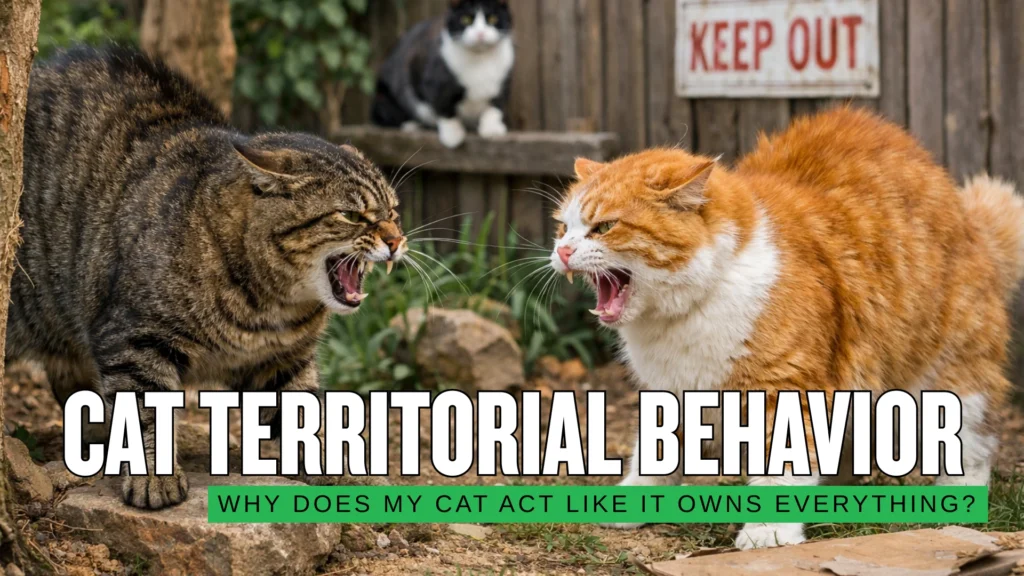

Cat Territorial Behavior, You walk into your living room, and your cat gives you a cold, judgmental stare as if YOU are the intruder. You bring home a new piece of furniture, and within minutes, your cat is rubbing its face all over it. A neighbor’s cat appears outside the window, and suddenly your sweet, lovable pet transforms into a hissing, growling beast.
Sound familiar?
If you are a cat owner, you have almost certainly witnessed cat territorial behavior firsthand. But why do cats act this way? Is it normal? And more importantly, what can you do about it?
In this comprehensive guide, we will dive deep into the world of cat territorial behavior. You will learn what it is, why it happens, what triggers it, and how to manage it so that both you and your cat can live in peace.
Let’s get started.

WHAT IS CAT TERRITORIAL BEHAVIOR?
Cat territorial behavior refers to the set of actions cats use to establish, defend, and communicate ownership over a specific area or space. Unlike dogs, who are pack animals and generally comfortable sharing territory with others, cats are solitary hunters by nature. This means their instinct to claim and protect personal space is deeply hardwired into their DNA.
In the wild, a cat’s territory is not just about comfort. It is about survival. A defined territory gives a cat reliable access to food sources, safe sleeping and resting areas, mating opportunities, and protection from rival animals.
Even though your indoor cat does not need to hunt for food or fight off predators, thousands of years of evolutionary programming do not simply disappear. Your cat still operates with the instincts of its wild ancestors, and territorial behavior is one of the most prominent expressions of those instincts.
Cat territorial behavior is completely normal and natural. However, when it becomes excessive or aggressive, it can create problems for other pets, for guests, and even for you.
THE SCIENCE BEHIND WHY CATS ARE TERRITORIAL
To truly understand cat territorial behavior, we need to examine the biology that underlies it.
- Solitary Hunter Instincts
Domestic cats (Felis catus) descended from the African wildcat (Felis silvestris lybica), a solitary predator. Unlike lions, which live in prides, wildcats hunt and survive alone. This means each wildcat needs exclusive access to a hunting range large enough to sustain itself.
This solitary lifestyle led to the evolution of complex territorial systems. Cats developed ways to mark, communicate, and defend their space without constant physical confrontation, because fighting is risky and energy-costly.
- Scent Glands and Chemical Communication
Cats have scent glands located in several parts of their body, including the face (cheeks, chin, forehead), the paws, the tail base, and the flanks.
When your cat rubs against furniture, walls, or even your legs, it is depositing pheromones from these glands. These chemical signals tell other cats that this space belongs to them.
This form of communication is incredibly efficient. A scent mark left on a tree or piece of furniture can communicate information long after the cat has moved on, almost like leaving a message for other cats to read.
- The Role of Stress and Cortisol
Research has shown that territorial stress in cats is directly linked to elevated cortisol levels (the stress hormone). When a cat feels its territory is threatened, its body enters a heightened state of alertness. Over time, chronic territorial stress can lead to serious health problems, including over-grooming and fur loss, urinary issues like inappropriate urination, loss of appetite, and increased aggression.
Understanding this biological response helps explain why cat territorial behavior can sometimes seem intense or disproportionate. For your cat, it is a genuine survival signal.
COMMON SIGNS OF CAT TERRITORIAL BEHAVIOR
Cat territorial behavior manifests in many different ways. Some are subtle, others are impossible to miss. Here are the most common signs to watch for:
Urine Marking (Spraying)
This is perhaps the most well-known sign of cat territorial behavior. Cats spray urine on vertical surfaces such as walls, furniture, and doors to leave strong scent signals for other cats. This is different from normal urination. Spraying involves small amounts of urine deposited at nose height for other cats to detect.
Both male and female cats can spray, though intact (unneutered) males do it most frequently.
Rubbing and Bunting
When your cat rubs its face on you, on furniture, or on doorframes, it is engaging in a behavior called bunting. This is a friendly but deliberate act of scent-marking. Your cat is essentially saying, “This is mine, and I like it.”
This behavior is generally a positive sign of comfort and security. When your cat rubs against you, it is including you as part of its territory, which is actually a compliment.
Scratching Surfaces
Scratching serves two territorial purposes at once. First, it deposits scent from the paws’ glands. Second, it leaves visible scratch marks as a visual signal to other cats.
This is why cats often scratch in prominent, visible places, such as the corner of a sofa or a door frame. They are not being destructive on purpose. They are communicating.
Staring and Blocking
Cats use body language to assert territorial dominance. If your cat sits in a doorway and refuses to let another pet pass, stares down a newcomer, or positions itself in the center of the room, it is displaying classic territorial posturing.
Hissing, Growling, and Swatting
When a territorial warning is ignored, cats escalate to more overt aggression. Hissing, growling, and swatting are the cat’s way of saying: “I have warned you. Now I am serious.”
Chasing and Fighting
In multi-cat households or when an outdoor cat enters the yard, territorial disputes can escalate to actual physical chasing or fighting. These altercations can result in injuries, so it is important to intervene before they reach this point.
Hiding or Withdrawing
Not all cats respond to territorial threats with aggression. Some cats, especially more timid ones, will withdraw, hide, or stop eating when they feel their space is being invaded. This is a stress response and should be taken seriously.

WHAT TRIGGERS CAT TERRITORIAL BEHAVIOR?
Understanding the triggers of cat territorial behavior is key to managing it. Here are the most common causes:
A New Pet in the Home
Bringing home a new cat, dog, or even a small animal like a rabbit can immediately activate your existing cat’s territorial instincts. To your cat, this newcomer is an intruder in its established space.
The intensity of the reaction depends on your cat’s personality, age, past socialization experiences, and how the introduction is handled.
Moving to a New Home
Cats are creatures of habit, and their territory is deeply associated with familiar scents, spaces, and routines. Moving to a new home can be extremely disorienting and stressful.
In a new environment, your cat will immediately begin the process of establishing territorial markers. Expect increased rubbing, scratching, and possibly some spraying until your cat feels secure.
Changes in the Household
Major life changes such as a new baby, a new partner moving in, rearranged furniture, or even a change in your schedule can disrupt your cat’s sense of territorial security. Cats are sensitive to change, and disruption of their routine can trigger territorial anxiety.
Outdoor Cats Visible Through Windows
Even an indoor cat can become highly agitated by the sight of another cat outside the window. This is known as redirected aggression or window aggression. Your cat cannot confront the perceived intruder directly, so it may redirect its frustration toward you or another pet in the home.
Intact (Unneutered/Unspayed) Status
Hormones play a major role in territorial behavior. Unneutered male cats are significantly more likely to spray, roam, and fight. Unspayed females can also display territorial aggression, especially when in heat. Spaying and neutering dramatically reduces, though does not always eliminate, territorial marking and aggression.
Insufficient Resources
In multi-cat households, competition over resources like food bowls, water stations, litter boxes, and sleeping spots can trigger ongoing territorial conflict. The general rule is to provide one resource per cat, plus one extra.
CAT TERRITORIAL BEHAVIOR IN MULTI-CAT HOUSEHOLDS
Managing cat territorial behavior becomes significantly more complex when you have multiple cats. Unlike dogs, cats do not naturally form hierarchies through submission. Instead, they negotiate territory through avoidance, scent marking, and occasional confrontation.
In a multi-cat home, you may notice one cat consistently eating first or monopolizing the best sleeping spots, one cat blocking doorways or hallways to control access, tension during feeding times, or occasional hissing, swatting, or chasing.
This does not always mean your cats dislike each other. In many cases, cats in the same household develop a time-sharing arrangement, where they use the same spaces at different times to minimize conflict.
How to Reduce Territorial Conflict in Multi-Cat Homes
- Provide multiple feeding stations in different locations.
- Use multiple litter boxes (one per cat, plus one extra).
- Create vertical space with cat trees and shelves. More territory means less competition.
- Ensure each cat has its own sleeping area.
- Use synthetic feline pheromone diffusers, such as Feliway, to reduce overall stress.
- Never force cats to interact; let them set the pace.
HOW TO MANAGE AND REDUCE CAT TERRITORIAL BEHAVIOR
Whether your cat is displaying territorial behavior toward other pets, guests, or even you, there are effective strategies to manage it.
Spay or Neuter Your Cat
This is the single most effective step you can take to reduce territorial marking and aggression driven by hormones. Neutered males are far less likely to spray, roam, or fight. The earlier this is done, the more effective it tends to be.
Proper Introduction of New Pets
Never introduce a new pet into your existing cat’s space without a careful process. A proper introduction should take place over several days to weeks:
Step 1 – Separate spaces: Keep the new pet in a separate room for the first few days. Allow both animals to get used to each other’s scents under the door.
Step 2 – Scent swapping: Exchange bedding between the two animals so they can investigate each other’s scent in a non-threatening way.
Step 3 – Controlled visual contact: Use a baby gate or cracked door to allow supervised visual contact without direct access.
Step 4 – Supervised meetings: Allow brief, supervised meetings in a neutral space. Keep these sessions positive and short.
Step 5 – Gradual integration: Slowly extend the time the animals spend together as comfort levels increase.
Patience is essential. Rushing this process is the number-one cause of failed introductions.
Expand Your Cat’s Territory
Limited space often intensifies territorial conflict. You can effectively increase your cat’s perceived territory by:
- Installing cat shelves or wall-mounted perches
- Providing tall cat trees near windows
- Creating cat highways and pathways along walls that allow cats to move through the home without encountering each other at ground level
More vertical space equals more territory, which means less competition.
- Use Synthetic Pheromones
Products like Feliway mimic the natural feline facial pheromone, the one your cat deposits when it rubs its face on things. These synthetic pheromones signal safety and familiarity, helping to reduce territorial anxiety.
Plug-in diffusers are ideal for whole-room coverage. Sprays can be used on specific furniture or areas.
- Stick to a Consistent Routine
Cats thrive on routine. Consistent feeding times, play sessions, and sleeping arrangements help your cat feel secure in its territory. A predictable environment reduces stress and, in turn, reduces the intensity of territorial behavior.
- Provide Adequate Mental and Physical Stimulation
Boredom and pent-up energy can amplify territorial tendencies. Make sure your cat has:
- Daily interactive play sessions of at least 15 to 20 minutes
- Puzzle feeders to engage natural hunting instincts
- Window perches with a view (bird feeders placed outside are a great enrichment tool)
- Rotating toys to keep things interesting
- Consult a Veterinarian or Feline Behaviorist
If your cat’s territorial behavior is severe, involving injury, chronic spraying, or extreme stress, it is time to consult a professional.
Your vet can rule out underlying medical causes. Urinary tract infections, for example, can cause inappropriate urination that mimics territorial spraying. A certified cat behaviorist can develop a customized behavior modification plan for your specific situation.

WHEN IS CAT TERRITORIAL BEHAVIOR A PROBLEM?
Most cat territorial behavior is completely normal and does not require intervention beyond basic management. However, you should seek professional help if:
- Your cat is injuring other pets or people.
- Territorial aggression is escalating rather than stabilizing over time.
- Your cat is spraying excessively despite being spayed or neutered.
- Your cat shows signs of chronic stress, such as over-grooming, hiding, or loss of appetite.
- A new pet introduction has completely failed after weeks of careful effort.
Early intervention is always better than waiting for the problem to escalate.
INTERESTING FACTS ABOUT CAT TERRITORIAL BEHAVIOR
- A feral cat’s territory can cover anywhere from “0.1 to 1.235 acres”, depending on food availability and population density.
- Cats can recognize their own scent marks and use them to navigate their territory, essentially reading a map they wrote themselves.
- Female cats tend to have smaller territories than male cats.
- Many cats in feral colonies develop complex social structures with shared, overlapping territories.
- Indoor cats generally have their territorial instincts focused on the home and its immediate surroundings, including what they can see through windows.
CONCLUSION
Cat territorial behavior is one of the most natural, deeply ingrained aspects of your cat’s personality. It is not a flaw, a sign of a bad cat, or something to be ashamed of. It is simply your cat being a cat.
By understanding why your cat behaves territorially, including the biology, the triggers, and the communication behind it, you become a better, more empathetic cat owner. And with the right strategies in place, you can manage territorial behavior effectively, keeping your cat happy, secure, and well-adjusted.
Remember: a cat that feels safe and secure in its territory is calmer, healthier, and more affectionate. Give your cat the space, resources, and consistency it needs, and it will reward you with all the head bumps and purrs you can handle.
QUICK REFERENCE: KEY TAKEAWAYS
- Cat territorial behavior is normal and rooted in wild survival instincts.
- Common signs include spraying, rubbing, scratching, hissing, and blocking.
- Major triggers include new pets, moving homes, household changes, and visible outdoor cats.
- Spaying and neutering are the single most effective ways to reduce hormonal territorial behavior.
- Multi-cat households benefit from increased resources and vertical space.
- Synthetic pheromones, consistent routines, and proper pet introductions all help manage territorial behavior.
- Seek professional help if behavior is severe, escalating, or causing injury.
A: Not exactly. Territorial behavior is a broader category that includes marking, patrolling, and posturing. Aggression is one possible outcome when territorial boundaries are challenged, but many territorial behaviors, like rubbing and scratching, are not aggressive at all.
A: Yes. While intact male cats display the most intense territorial behavior (especially spraying), female cats are also territorial. Spayed females can still exhibit marking, guarding, and aggressive territorial responses.
A: Territorial behavior cannot be completely eliminated because it is instinctual. However, it can be significantly reduced and managed through environmental enrichment, proper introductions, spaying or neutering, and consistent routine.
A: This is called redirected aggression. Your cat is aroused by the sight of an outdoor cat (a territorial threat) but cannot confront it directly. The pent-up arousal gets redirected toward the nearest available target, often you or another pet. Block your cat’s view of outdoor cats if this becomes a regular problem.
A: Territorial tendencies typically begin to emerge as kittens reach sexual maturity, usually between 6 and 12 months of age. This is one reason early spaying and neutering are recommended.
Related Article: